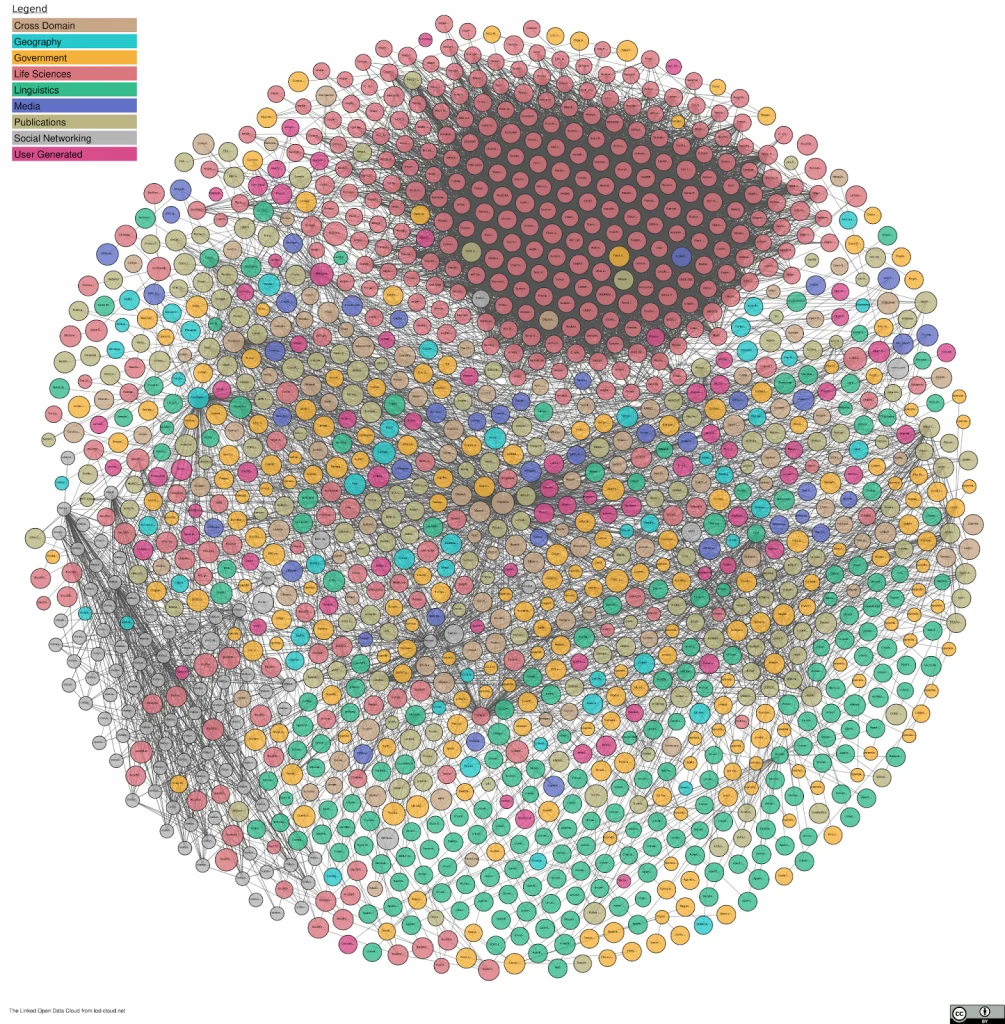
Web 3.0, often described as the ‘semantic web’, utilises technologies like the Resource Description Framework (RDF) to enable systems to capture and encode data in natural language (Burke, 2019; Cambridge Semantics, 2016; The Fitzwilliam Museum; Joiner, 2018).
RDF is a data model that names data objects and the relationships between them using Universal Resource Identifiers (URIs) (Zaidman et al., 2013). This process creates a web of “linked data” that transforms the internet into a global database (Zaidman et al., 2013).
Cambridge Semantics (2016, March 6). An introduction to the semantic web [Video]. https://www.youtube.com/watch?v=V6BR9DrmUQA
The five principles of linked data according to Zaidman et al. (2013) are that data is:
- Available on the web
- Structured and machine-readable
- Non-proprietary
- Using open data standards
- Linked to other people’s data
The Fitzwilliam Museum. (2022, April 2). How does Linked Data Work? What can it do for museum collections? https://www.youtube.com/watch?v=0m79yDb4AzE
Within the archives sector, linked data could utilise ‘big data’ generated by digitisation and large-scale datasets to create Archival Linked Data from catalogue data and metadata of digitised and born-digital archives (Hawkins, 2022, p.321; Joiner, 2018, pp.102-194).
A notable example is the UK National Archives project connecting linked data with geo-referencing, allowing users to search and connect geographical information about the archival records (Clough, 2011; Hawkins, 2022, p.324). While projects of this type have demonstrated benefits for improving access, they also face significant barriers to make them scalable given the prevalence of large amounts of unstructured data and the lack of an Archival Linked Data Infrastructure (Hawkins, 2022, pp.329-330).

References
Burke, J. (2019). Neal-Schuman library technology companion : A basic guide for library staff (6th ed.). American Library Association.
Cambridge Semantics (2016, March 6). An introduction to the semantic web [Video]. https://www.youtube.com/watch?v=V6BR9DrmUQA
Clough, P., Tang, J., Hall, M.M. & Warner, A. (2011). Linking archival data to location: a case study at the UK national archives. Aslib Proc, 63(2–3):127–147. https:// doi. org/ 10. 1108/ 00012 53111 11356 28
Hawkins, A. (2022). Archives, linked data and the digital humanities: increasing access to digitised and born-digital archives via the semantic web. Archives and Museum Informatics, 22(3), 319–344. https://doi.org/10.1007/s10502-021-09381-0
The Fitzwilliam Museum. (2022, April 2). How does Linked Data Work? What can it do for museum collections? https://www.youtube.com/watch?v=0m79yDb4AzE
Joiner, I. (2018). Emerging library technologies: It’s not just for geeks. Chandos Publishing.
Zaidman, M., Hausenblas, M., Wood, D. & Ruth, L. (2013). Linked Data. Manning Publications. https://learning.oreilly.com/library/view/linked-data


