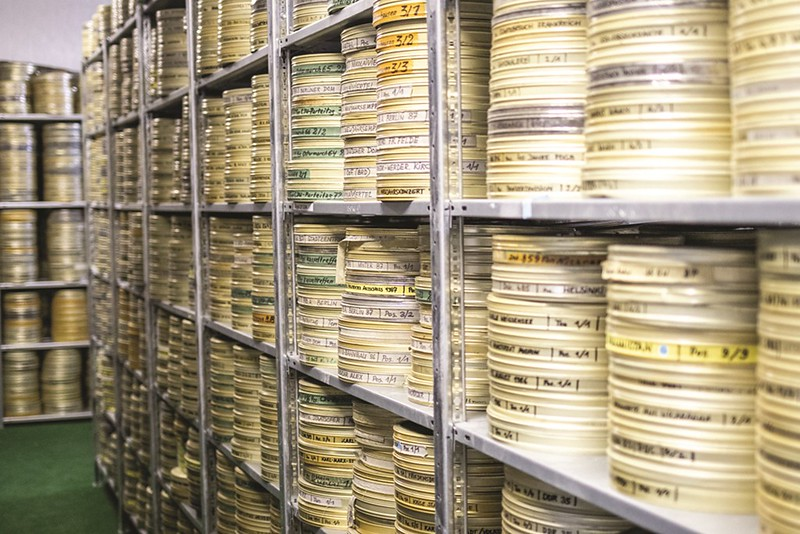
As digital media creation continues at breakneck speed, cultural organisations holding heritage audiovisual material search for viable solutions to preserve and manage valuable records, often held in obsolete media formats. From open-source to custom-built archiving solutions, these are some of the ways cultural institutions are “futureproofing” audiovisual archives.
Custom-built solutions at the NAA
Like other cultural institutions in Australia, the National Archives of Australia (NAA) set 2025 as the year to complete the “futureproofing” of their audiovisual collections. Why 2025? Because research indicated that by 2025 equipment obsolescence and the loss of skilled staff would make the digitisation and integration of audiovisual collections significantly more difficult and risk the permanent loss of heritage material.

The NAA manages more than one million physical and digital audiovisual assets and is responsible for access to these digital and non-digital items across Australia. At a significant financial and resource cost, the first phase of the NAA’s Future Proof project begun in 2020 was to digitise 30,000 recordings vital to Australia’s sound heritage.
In addition to the audiovisual content, the NAA’s asset management systems hold records for each item with descriptive data, provenance, and technical details. One of the issues that had to be resolved by the “futureproofing” project was the implementation of an integrated asset management system that would be able to hold the NAA’s audiovisual repositories, at the time stored on separate databases in Sydney.
Working with TransMedia Dynamics, the company that had developed and implemented MediaFlex-UMS for the National Film and Sound Archives (NFSA), the NAA wanted a scalable and proven audiovisual archive solution that could eliminate the need for separate databases. MediaFlex-UMS was adapted to meet the NAA’s requirements, incorporating several separate databases into an integrated asset management solution. Out of this innovation, TransMedia Dynamics developed a proprietary system, Paragon for Archiving, that could be implemented by smaller organisations and upgraded to Media-Flex-UMS as needed.
Under its Digital Preservation Policy, NAA must “secure, preserve and provide access to digital records of enduring value.” Paragon’s open architecture and robust metadata tracking allow NAA to embed preservation metadata and access controls directly into the storage layer, aligning with the NAA’s requirement to maintain authenticity and integrity of Commonwealth records in digital form
WGBH, a public broadcaster based in Boston, Massachusetts, produces 30 per cent of the content transmitted by the USA’s Public Broadcasting Service (PBS). The Media Library and Archives (MLA) unit of WGBH oversees the preservation and management of the organisation’s media assets (Cariani & Green, 2020; Davis Kaufman et al., 2019).
Adapting open-source options at WGBH
WGBH has generally required two separate asset management systems to administer production systems, and library and archive systems. The requirement for two separate systems is due to the large volume of descriptive metadata required by the library and archive system, including information about provenance, technical specifications, and preservation, that would hinder the production system.

Seeking a single system for “production tracking and archiving”, WGBH trialled a vendor-licensed system with limited success. The system required a large number of customisations to meet WGBH’s needs that the vendor was unable or unwilling to accommodate.
MLA staff at WGBH began working with the Samvera open-source platform to find a solution. They considered using Indiana University’s Avalon, a free, open-source asset management bundle built on the Samvera platform, but opted instead to begin development on AMS2.0, a collaborative project with the Library of Congress to “save at-risk public media”.
While AMS2.0 was a successful model that continues to be used, it was ultimately too limited for the needs of WGBH. MLA staff opted to adopt and extend the open-source asset management system Hyrax, a Samvera platform bundle that was already in development, for their Media Library and Archive. However, the extensive descriptive metadata capabilities of Hyrax were deemed too broad for production purposes for which Avalon was used instead.
Having started with a single, vendor-licensed system that met neither their production nor archiving needs, the deployment and extension of the open-source Samvera repository software enabled the public broadcaster WGBH to adopt two separate and highly customisable solutions for successfully managing its audiovisual assets.
Suggestions for further reading
Andrews, N. (n.d.) Digital Preservation at the NAA: DPC Audiovisual Working Group. Australian Government, Canberra. https://www.dpconline.org/doclink/dpc-av-working-group-presentation-naa
Cariani, K., & Green, R. (2020). Building open source audiovisual collections management systems on Samvera. Journal of Digital Media Management. 9(1), 40-50.
Davis Kaufman, C., Cariani, K., Roosa, S., Corum, J. and Myers, A. (2019). Implementing Samvera Open Source Technology at WGBH and the American Archive of Public Broadcasting Association of Moving Image Archivists. https://www.slideshare.net/WGBH_Archives/implementing -samvera-open-source-technology-at-wgbh-and-the -american-archive-of-public-broadcasting
National Archives of Australia (NAA). (2021b). Digital Continuity 2020 Policy Report. (ORIMA Research). https://naa.govcms.gov.au/evaluation-agency-implementation-dc2020-policy
National Film and Sound Archives (NFSA). (2016). Collection development strategy. https://www.nfsa.gov.au/collection/curated/asset/82870-collection-development-strategy
TransMedia Dynamics (TMD). (2021). Paragon for Archiving. https://www.tmd.tv/wp-content/uploads//SOLUTION-BRIEF_Paragon-for-Archiving_A4.pdf
TransMedia Dynamics (TMD). (2020). Case studies: National Archives of Australia Audiovisual Asset Management and Preservation System (AVAMS). https://www.tmd.tv/project/national-archives-of-australia-case-study/ 3/8


